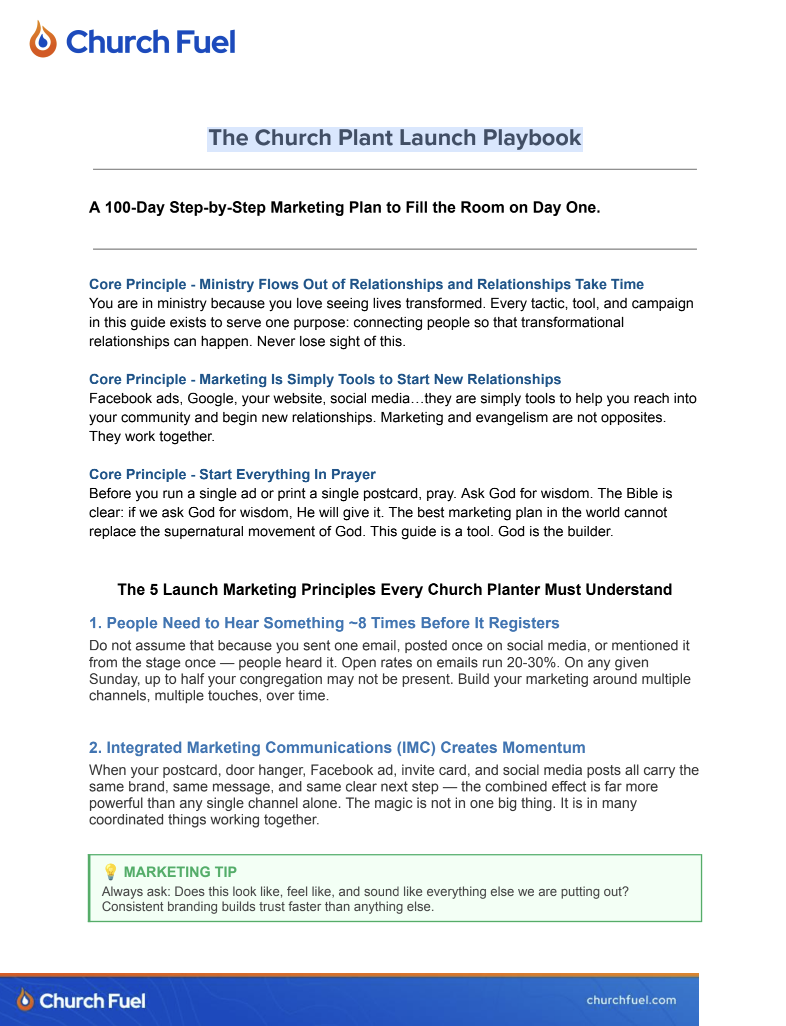
If the word “marketing” makes you a little uncomfortable, you’re not alone. Most pastors didn’t go to seminary to talk about funnels, conversion rates, or cost-per-click. You went to preach the gospel, shepherd people, and build the church. And somewhere along the way, someone started asking if you’d boosted the Easter post yet.
Here’s the good news: marketing, at its core, is not a worldly concept you have to baptize. It’s a set of tools. And tools are neutral. A hammer can frame a house or break a window. A microphone can amplify a sermon or blast profanity. Facebook can spread division or deliver a grieving mom a message about your grief support group at exactly the moment she’s searching.
- Technology accelerates
- Money amplifies
This guide is built for pastors who want to have real conversations with marketing experts, staff, agencies, and volunteers without feeling lost. It is part glossary, part framework, part permission slip. When you finish, you’ll be able to sit in a meeting and say, “Okay, so our cost per lead is climbing because our landing page CTA isn’t converting and we’re running the wrong audience,” and actually mean it.
More importantly, you’ll see that almost every marketing term has a ministry equivalent.
We’re not learning a new religion. We’re learning a new vocabulary for something you’ve been doing since the first invitation card was printed on cardstock in 1978.
Part 1: The Four Big Ideas
Before terms and tactics, you need four foundational ideas. If you only remember these, you’ll be ahead of 90% of pastors having marketing conversations.
1. Marketing is just tools to help you start new relationships.
That’s it. That’s the whole definition. Marketing is not manipulation, pressure, or “selling” Jesus. It is the set of tools that creates the first conversation between your church and someone who doesn’t know you yet.
Think about it this way: in the first century, Paul used the Roman road system to plant churches. That road system was infrastructure built by a pagan empire — and God used it to carry the gospel across the known world. Today, Google, Facebook, Instagram, YouTube, email, and SMS are the Roman roads. Marketing is simply the skill of using those roads on purpose.
2. Ministry flows out of relationships.
You can’t disciple someone you don’t know. You can’t pray for someone whose name you don’t have. You can’t invite someone to a small group who’s never heard of your church. Everything downstream in ministry — baptism, membership, serving, giving, discipleship — flows from a relationship that had to start somewhere.
Marketing’s entire job is to help that relationship start.
3. Relationships take time.
No one walks into your church on Sunday as a stranger and gets baptized that afternoon. (Well, almost no one. The Ethiopian eunuch is the exception, not the rule.)
People move slowly. They visit the website. They watch a sermon clip. They drive past the building. They lurk on Instagram. They talk to a friend. Eventually, sometimes months later, they show up.
Every marketing decision should be evaluated through that lens. We are not trying to close a sale by Friday. We are trying to begin — and then patiently nurture — a relationship that may not bear visible fruit for a year or more.
4. Relationships can begin the moment you have contact information.
This is the hinge of everything. If someone walks through the lobby, smiles, and drives away, you have no ministry relationship with them. None. You can’t follow up. You can’t pray for them by name. You can’t invite them to the next thing.
But the moment they give you a first name, last name, mobile number, or email address, something shifts. Now you have a way to serve them. Now you have a seed. That’s why “capturing contact information” — a very marketing-sounding phrase — is actually one of the most pastoral things your church can get good at.
It’s not marketing. It’s ministry.
Part 2: Ministry Frameworks That Explain Marketing
You already understand how relationships work in your church. You just haven’t mapped that understanding to the language marketers use. Here are three frameworks that bridge the gap.
Framework 1: Concentric Circles
This framework can be a helpful way for a pastor to think about where every person in your orbit actually is. Imagine five rings, from the outside in:
- Community — Everyone in your city. Most don’t know your church exists. This is your mission field.
- Crowd — People who have shown up at least once. Sunday attenders. Website visitors. People who’ve watched a sermon online.
- Congregation — Members. Regulars. People who call your church “my church.”
- Committed — Disciples who are actively growing. Small group members. Servants. Givers.
- Core — Leaders. Elders. Staff. The people who make the ministry happen.
Now here’s the marketing insight: every tool you’ll ever use — ads, emails, landing pages, invitations, text messages — has one job, which is to move someone one ring closer to the center.
- An ad introduces Community to the idea of your church.
- A landing page moves them from Community to Crowd.
- A connect card moves them from Crowd to Congregation.
- A small group invitation moves them from Congregation to Committed.
When a marketing expert says “top of funnel,” they mean Community. When they say “bottom of funnel,” they mean Committed. Same concept, different words.
Framework 2: Know, Like, Trust
This is a classic marketing framework borrowed from relationship-based sales, and it maps beautifully onto how people become part of your church.
- Know — They’re aware you exist. They’ve seen the logo. They drove past the building. They saw an ad. That’s it.
- Like — They’ve engaged with something. They watched a sermon clip. They read a blog post. They followed the church on Instagram. They’ve decided you seem like a church they’d consider.
- Trust — They’ve taken a real step. They visited. They filled out a connect card. They came to a class. They met the pastor. They’re letting you speak into their life.
The reason this matters: Most pastors try to jump people from “Know” straight to “Trust.” That’s why bulletin-insert invite cards rarely work. You’re asking for “trust” before you’ve earned “like.” Every piece of marketing should ask, “What stage is this person in, and what’s the next small step I can offer them?”
Framework 3: The Temperature of a Relationship
Marketers often talk about “cold,” “warm,” and “hot” leads. For pastors, that language feels clinical — like we’re selling used cars. But it’s actually describing something you already know intuitively.
- Cold — Someone who has never heard of your church. A stranger. They’re not hostile; they just don’t know you. Cold outreach is the spiritual equivalent of a missionary knocking on a door in a village they’ve never been to.
- Warm — Someone who has had some exposure to you. Maybe they saw the Facebook ad. Maybe a friend invited them. Maybe they visited the website last month. They’re open. They know the name. You’ve built a little bit of familiarity.
- Hot — Someone who has given you contact information or taken an action. They filled out a form. They texted in to the keyword. They walked up to the Connect Desk. They’re asking to hear from you.
A hot lead deserves a phone call from a pastor/leader within 24 hours. A warm lead deserves a well-crafted email sequence. A cold audience deserves a low-pressure invitation — not a hard ask. When a marketer says “you’re treating a cold audience like a hot one,” what they mean is, “Pastor, you’re asking someone to join a small group when they don’t even know what your church is called yet.”
Part 3: The Law of the List
If you take away one tactical principle from this entire guide, make it this one:
A growing church requires a growing list.
A “list” is just the collection of people you have permission to contact. At minimum, that’s first name, last name, mobile number, and email address. Every single person on that list represents a ministry relationship that is available to your church. You can pray for them. You can invite them. You can serve them. You can disciple them. You can send them a text when tragedy hits your city and you want them to know the church is praying.
People not on your list? You can’t do any of that. They are effectively invisible to your ministry systems, no matter how much you love your community in the abstract.
This is why a healthy church is always doing two things simultaneously:
- Adding new people to the list (what marketers call “lead acquisition”) and
- Deepening relationship with people already on the list (what marketers call “lead nurturing”).
Acquisition without nurturing is a leaky bucket — you keep pouring people in and they keep falling out the bottom. Nurturing without acquisition is slow decline — you take great care of the people you have, but your list shrinks every year through death, relocation, and drift.
Every ministry effort can be evaluated by asking two questions:
- Did this grow our list?
- Did this deepen a relationship with people already on our list?
If the answer to both is no, that ministry is essentially invisible — no matter how well-executed it was.
Part 4: The Pastor’s Glossary of Marketing Terms
The rest of this guide is a reference. You don’t need to memorize it. You just need to know it’s here so that the next time a staff member or agency says a word that sounds like it belongs on Wall Street, you can quietly look it up and keep the conversation going.
Terms are grouped by category.
The Big-Picture Words
Marketing — The set of tools used to help start new relationships. In ministry: the front door of everything downstream.
Lead — Any person who has expressed some interest in what you offer, usually by giving you a way to contact them. In ministry: a person God has put in front of you, along with permission to follow up.
Lead Acquisition — The work of getting new people onto your list. In ministry: meeting new people and gaining permission to stay in touch.
Lead Nurturing — The ongoing work of building trust with people already on your list through consistent, helpful communication. In ministry: shepherding at a distance until a deeper relationship can form.
Funnel — A visual way of describing the path a person takes from stranger to committed member. Wide at the top (lots of people), narrow at the bottom (a few disciples). In ministry: identical to the concentric circles framework.
Pipeline — A specific sequence of stages a person moves through, often tracked in a CRM. For example: Visitor → Connect Card → First Conversation → Attended Class → Member. In ministry: a disciple-making pathway, documented.
Conversion — The moment someone takes a specific desired action — filling out a form, attending a service, joining a group. Does not mean “getting saved” in this context. In ministry: a person said yes to a Next Step.
Call to Action (CTA) — The clear, specific next step you’re inviting someone to take. For example “learn more,” or “Reserve your seat for Easter” or “Text Prayer to 417-777-7777.” In ministry: helping someone take a clear next step, because people need to be invited to do things specifically, not vaguely.
The List, Contacts, and CRM
List — The database of people you have permission to contact. The Law of the List says: if your list isn’t growing, neither is your church.
Contact — A person on your list, usually with name, email, and phone number attached. The unit of ministry possibility.
CRM (Customer Relationship Management) — The software where your list lives — Church Fuel, Planning Center, Church Community Builder, Text In Church, etc. In Ministry: Your shepherd’s notebook, digitized.
Segment — A slice of your list based on some criteria — first-time visitors, parents of preschoolers, Spanish-speakers, people who attended Easter but haven’t come back. In Ministry: Different groups of people who need different kinds of shepherding.
Tag — A label applied to a contact to mark something about them — “attended Easter,” “has kids,” “gave for the first time.” Tags are how you build useful segments. In Ministry: The pastoral notes you’d keep in your head if you only had 30 people. With 800, you need software.
Opt-in — When someone gives you explicit permission to email or text them. Required by law (CAN-SPAM, TCPA). In Ministry: The digital version of someone saying, “Yes, Pastor, you can follow up with me.”
Opt-out / Unsubscribe — When someone removes themselves from your list. Normal, healthy, and legally required to honor. Don’t take it personally!
Websites, Landing Pages, and Forms
Landing Page — A single web page built for one specific purpose — usually to capture a contact or drive one specific action. Different from a website homepage, which tries to do many things. In Ministry: A focused invitation to one specific next step.
Homepage — The front door of your website. Should answer in five seconds: Who are you? Where are you? When should I show up? What happens when I show up?
Form — The fields a person fills out to submit their information. Fewer fields = more completions. In Ministry: The connect card, online.
Connect Card — The physical or digital form by which someone gives you permission to follow up. The single most valuable piece of paper or pixels in your church.
Lead Magnet — Something valuable you give away in exchange for contact information — a guide, a devotional, a video series. In Ministry: A generous gift that begins a relationship. Think of it like a free booklet at a bookstore’s front table.
Thank You Page — The page someone lands on after submitting a form. Prime real estate for a Next Step — “Watch this welcome video from the pastor,” or “Here’s what happens on Sunday.”
SEO (Search Engine Optimization) — The practice of helping your website show up when someone Googles something relevant — “churches near me,” “grief support [your city],” “easter service [your city].” In Ministry: Being findable when someone is actively searching for what you offer.
Traffic — The number of people visiting your website. Traffic without conversion is a parade going past the church — lots of movement, no one coming in.
Bounce Rate — The percentage of website visitors who leave without doing anything. Lower is better.
UTM Parameters — Little tags added to the end of a web link that tell you where a visitor came from. Looks like nonsense to humans (“?utm_source=facebook”), but lets you know which invitation is actually working.
Email and Text Messaging
Email Sequence — A pre-written series of emails that go out automatically over days or weeks after someone joins your list. In Ministry: The follow-up conversations you’d have in person if you had infinite time.
Automation / Workflow — The behind-the-scenes logic that sends the right message at the right time based on what a person does. In Ministry: Pastoral care that happens without you having to remember every detail about every person.
Open Rate — The percentage of people who opened your email. A healthy church email hits 25–40%. Anything above 20% is acceptable.
Click-Through Rate (CTR) — The percentage of people who opened AND clicked a link. A healthy rate is 2–5%.
Deliverability — Whether your emails are actually arriving in inboxes instead of spam folders. Affected by list hygiene, sender reputation, and content.
SMS / Text Marketing — Text messages sent to opted-in contacts. Open rates are 90%+ because people read every text. Use sparingly and meaningfully — not for clever copy, for genuinely time-sensitive moments.
Keyword — In SMS, a word someone texts to a number to join a list (e.g., text EASTER to 417-777-7777). In SEO, a search term people type into Google. Same word, two meanings.
Short Code — The 5- or 6-digit number people text to join your list (like 94000). Different from your office phone. Most churches should move away from short codes towards a 10 digit local phone number.
Social Media
Organic Reach — The number of people who see your post without you paying to promote it. Organic reach on Facebook has been declining for years. Depending on it alone is a losing strategy.
Paid Reach — The number of people who see your post because you put money behind it. This is where “money amplifies” comes in — $50 intelligently spent can put your Easter invitation in front of 10,000 people in your zip code.
Boost — The simplest (and least powerful) form of paid social media — Facebook’s “Boost Post” button. Works, but leaves a lot of targeting and optimization on the table compared to running a real ad.
Engagement — Likes, comments, shares, saves. A rough signal that content resonated. Not the same as fruit — but not nothing.
Follower / Fan — Someone who chose to see your content regularly. Better than a stranger, worse than a contact on your list. You don’t own the relationship — the platform does.
Impression — One view of your content. Different from reach: if one person sees your post three times, that’s 1 reach and 3 impressions.
Algorithm — The invisible rules that decide whose content shows up in whose feed. Changes constantly. Not your friend, not your enemy — just the weather.
Facebook / Meta Ads
Ad Account — The account inside Facebook/Meta where your ads live and your billing happens. Separate from your church’s Facebook page.
Business Manager / Meta Business Suite — The hub where you manage pages, ad accounts, pixels, and access. If you don’t have one set up properly, you’re flying blind.
Pixel (Meta Pixel) — A tiny piece of code on your website that tells Facebook what people do after clicking. Enables retargeting and better optimization. Without it, you’re advertising with one eye closed.
Audience — The group of people your ad is shown to. Can be defined by location, age, interests, behavior, or existing customer lists.
Custom Audience — An audience you built yourself — uploaded from your existing list, or generated from website visitors, video viewers, or engagers.
Lookalike Audience — Facebook finds people who resemble your existing custom audience. Powerful for reaching new people who are statistically similar to your current members.
Retargeting — Showing ads specifically to people who already interacted with you — visited your site, watched your video, engaged with a post. The warmest audience you can advertise to.
CPM (Cost Per Mille / Cost Per Thousand Impressions) — How much it costs to show your ad 1,000 times. A measure of how expensive it is to reach eyeballs. In Ministry: How much you’re paying to be seen.
CPC (Cost Per Click) — How much each click on your ad costs you. Useful but not the whole story — a cheap click that doesn’t convert is worthless.
CPL (Cost Per Lead) — How much it costs to get one person onto your list. This is usually the number that matters most. If it costs you $4 to add a contact and 1 in 20 eventually attends, you’re paying $80 per first-time guest. Is that worth it? Almost always yes.
CPR (Cost Per Result) / CPA (Cost Per Action) — Same idea as CPL, generalized to whatever action you defined as your goal — a registration, a form fill, a sermon view.
CTR (Click-Through Rate) — Percentage of people who saw your ad and clicked it. Ads with higher CTRs usually have lower CPCs — Facebook rewards relevance.
Frequency — The average number of times one person has seen your ad. Above 3–4, people start to get annoyed. Below 1.5, you’re not sticking.
Creative — The image, video, or copy of the ad itself. In a room full of marketers, “the creative” means “the thing people actually see.”
Campaign / Ad Set / Ad — The three-level structure of Meta ads. Campaign = the goal. Ad Set = the audience and budget. Ad = the creative. You can have multiple ads inside one ad set, multiple ad sets inside one campaign.
Facebook Lead Campaign (Meta Lead Ads) — A specific type of Facebook/Instagram ad that captures a person’s contact info inside the platform, using a pre-filled form, without making them leave to visit your website. Dramatically lower friction and higher conversion than sending traffic to a landing page. In ministry: the difference between “Here’s a flyer, go find our website” and “Give me your name and number and I’ll have the pastor call you tomorrow.”
Google Ads and Google Grant
Google Ads — Paid advertising on Google’s search results and display network. Churches can run these with regular dollars, or with the Google Ad Grant — $10,000/month in free advertising for qualifying nonprofits.
Google Ad Grant — Free advertising credit available to qualifying 501(c)(3) churches and nonprofits. Has specific rules (no single-keyword bidding, minimum CTR requirements, etc.), but it’s the single most underused ministry resource on the internet. Church Fuel helps hundreds of churches manage theirs.
Keyword (Google) — A word or phrase people type into Google that triggers your ad. “Churches near me” is a high-intent keyword. “Jesus” is not (too broad, wrong intent).
Search Ad — A text ad that appears in Google search results.
Display Ad — An image or banner ad that appears on websites around the internet via Google’s Display Network.
Quality Score — Google’s rating of how relevant your ad is to what someone searched. Higher = cheaper clicks and better placement.
Performance Max (PMax) — An all-in-one Google Ads campaign where you provide the creative (headlines, images, videos) and Google’s AI automatically decides where to show it — Search, YouTube, Gmail, Maps, and the Display Network — and to whom. You trade control for reach and efficiency. In ministry: handing a trusted volunteer team your invitation and letting them find the right person with the right message at the right time, instead of you directing every knock on every door.
Google AI Max — A set of AI features inside Google Search ads that automatically expand your keyword matching and generate new headline and copy variations based on what people actually search for. It helps your ads show up for searches you never thought to target. In ministry: the difference between a pre-written welcome script and a greeter wise enough to say the right thing in the moment.
Google Business Profile (GBP) — Formerly “Google My Business.” The free listing that appears when someone Googles your church name or “churches near me” — service times, photos, reviews, map pin. In ministry: the digital version of the sign on your building and the greeter at the door, all rolled into one. For many first-time guests, it’s the very first impression of your church.
Google Analytics (GA4) — The free Google tool that tells you who visits your website, where they came from, and what they did once they arrived. Without it, your website is a black box; with it, you can make real decisions based on real behavior. In ministry: the attendance sheet for your website.
Measurement and Reporting
Analytics — The data that tells you what’s actually happening.
- Google Analytics for websites,
- Meta Ads Manager for Facebook,
- your CRM for people.
In Ministry: The evidence that helps you make wise decisions instead of emotional ones.
KPI (Key Performance Indicator) — The one or two numbers that actually matter for a given effort.
- For a Christmas Eve campaign, your KPI might be “registrations.”
- For a small group push, it might be “people joined.”
ROI (Return on Investment) / ROAS (Return on Ad Spend) — Did this cost more than it returned? In Ministry: The “return” is usually people, not dollars — which makes ROI tricky but not irrelevant. A $500 Easter campaign that produces 15 first-time guests and 2 new members is a bargain.
Attribution — The work of figuring out which marketing effort actually caused a given result. Hard, because someone might see a Facebook ad, Google the church a week later, ask a friend, and then show up. Which one “caused” them to come? All of them, really.
Dashboard — A single screen showing your most important numbers at a glance. Saves you from drowning in reports.
Part 5: How to Have a Marketing Conversation
You now have enough vocabulary to have a productive conversation with any marketing professional. Here are a handful of questions that will instantly make you sound like you’ve been doing this for years.
- “What’s our cost per lead on this campaign, and how does that compare to last year?”
- “Are we retargeting our website visitors, or just running cold ads?”
- “What’s the CTA on our homepage? Is it clear enough that a first-time visitor knows what to do next?”
- “How are we nurturing the people who filled out a Connect Card but haven’t come back?”
- “What’s our email open rate, and is our list growing month over month?”
- “Are we using the Google Ad Grant? If not, why not?”
- “If someone moves from a first-time visitor to a small group member, how many steps did we ask them to take? Can we make that shorter?”
One Last Thing
Marketing language can feel sterile. Ministry language is warm. The truth is that both are trying to describe the same thing: the slow, patient, Spirit-led work of inviting people into a relationship with Jesus and his people.
When a marketer says “lead nurturing sequence,” you can translate that to “a way to consistently love, inform, and invite a person who doesn’t know us yet.” When they say “conversion,” you can translate that to “a moment where someone said yes to the next step.” When they say “funnel,” you can translate that to “the path someone walks from stranger to family.”
Marketing is just the tool. Ministry is the point.
Technology accelerates. Money amplifies. Tools are neutral. And the church that learns to pick them up on purpose will reach more people than the one that refuses to touch them.