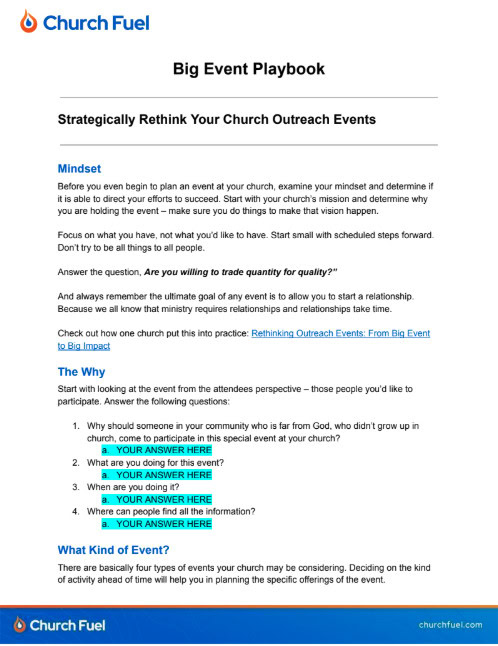
Rethinking Outreach Events
One Church’s Journey from “Big Event” to “Big Impact.”
The History of Outreach Events at Friendship Church
The mission of Friendship Church is to reach people in our community with the life-changing message of Jesus. As part of that, we hold three major community outreach events each year. These events coincide with holidays:
- An Easter Egg Hunt in the spring
- Trunk or Treat in the fall
- Living Nativity for Christmas
We typically schedule our Easter and Christmas events the week before the holiday. That way, we can invite attendees to holiday Sunday services. We usually follow the Trunk or Treat event with a ‘special’ Sunday characterized by an extra value-add in the kids’ ministry area.
All three events have been hugely successful in terms of attracting large numbers of families to the campus. Typically, we see several hundred to 1,000 attendees for each event. All of our outreach events are free to the community and are attended by some of the same families year after year, event after event.
As part of our follow-up for the events, we’ve sent emails and texts, inviting people back to Sunday services (especially Easter and Christmas). We also send invitations to other events within the next 2-6 months (VBS/summer camp, marriage night and the next community outreach event). Occasionally, we also send value-add emails providing resources for families.
Do Big Outreach Events Lead To Relationships?
The idea behind the events has been to:
- Combine the community’s interest in fun, high-quality holiday activities with the Gospel message, and
- Create an opportunity to invite people onto the church campus and start a relationship with them.
When it comes to events, we’ve successfully attracted many attendees, but we have not really been successful in starting long-term relationships or getting people to actually come back to a Sunday service. We suspect the people who attend are shopping for events but not necessarily shopping for a church. This might be because they have no interest, or because they attend another church already.
Despite this, we don’t see the events as unsuccessful. After all, we’re planting seeds as we present the Gospel message to everyone who opts into that part of the event. Typically, this is a fun presentation like a puppet show or skit. It’s also good for brand awareness. Because of our outreach events, people come to know that Friendship Church exists. The events are also an excellent venue to reconnect with people from the church who have slipped into irregular Sunday attendance or have stopped attending completely, with 100+ volunteers gathering around a common goal to staff the events.
After a couple of years of following this pattern for big events, our hope was to combine the appeal of community events, the benefits of sharing the Gospel message, and the engagement of volunteers, with a better way to start and maintain long-term relationships with people. Unfortunately, that didn’t happen …
The Big Question: Are You Willing To Trade Quantity For Quality?
After several conversations with Church Fuel’s Ryan Wakefield, discussing follow-up with event visitors and the low number of people who went from an event to a visit on Sunday morning, Ryan asked us a pivotal question:
“Are you willing to trade quantity for quality?”
This question prompted a conference call between Ryan and the Friendship Church leadership team. We were willing to make that trade but were unsure how to make it happen.
The overall strategy, according to Ryan, in making this type of transition included:
- Reducing the difference between the event and Sunday morning experience.
- Getting people in the building to experience what a Sunday morning is like.
- Allow for relationship building / connecting with the people of the church.
Examples of Sunday Morning Outreach Events
Ryan shared some ideas and examples of how this strategy could work:
Example #1: A Glow-in-the-Dark Party on Easter
For this event, a worship service in kids’ church would start with kids using glow sticks during the first song, and use black lights, giveaways, etc. This party would not be a separate experience. Rather, it’d be part of a Sunday experience. The following week, we could create something a little special but not as amped up as Easter.
Example #2: A Tailgate Weekend
This event could include food trucks, inflatables, fun in service, a message with a sports theme, and giveaways, all wrapped around Sunday service
Example #3: Christmas Adventure
A parking lot experience, tied into the Advent theme for a big Christmas service. People would have the opportunity to have their picture taken with Santa, see a camel, and the Grinch might even make an appearance! Again, this would not be a separate night, and not offsite. It would be part of our Christmas service, on our campus.
Example #4: Halloween 10/31 Party
Or, we could do the opposite. Instead of having an event, we could have the church not do anything. Instead, we could let our members be out in the community, meeting people and giving them invitations to hand out with their candy. This idea can be strategic, helping people connect relationally with their neighbors.
What We Liked:
After this conversation, we could see that some of the benefits to a Sunday morning event strategy were:
- We could weed out people who are coming from other churches, other towns, or who aren’t typically available to come on Sunday mornings. Instead, we’d mostly get people who can come back. We would get the opportunity to clearly preach the Gospel to them (in our service and in kids’ programming), and the opportunity to let God work on their hearts to bring them back.
- We’d be inviting them to what we’re going to keep inviting them back to. This helps create a culture of invitation and gives people an easy entry into church, even if they’ve never been or haven’t been to a church in a while.
- We already have systems in place for Sundays (greeters, connection strategies, kids programming, worship, etc.). Rather than recruiting volunteers and putting special programming into place, we can simply extend and increase what we already do well. We’re just adding more volunteers in each area doing what volunteers usually do there.
- Volunteer recruitment becomes easier and more strategic. People are already coming to church on Sundays, so we’re not asking for an additional commitment. As we add on additional resources for event Sundays, we have the opportunity to have these volunteers serve on subsequent Sundays.
- We can use the same systems for follow-up that we use every Sunday.
- We can use the time savings we get from not inventing an event and systems to support and make our ‘every week’ systems better.
How It Worked For Friendship Church
Trunk or Treat
After the conversation with Church Fuel, we decided to hold our Trunk or Treat event on a Sunday morning (the closest Sunday to 10/31) rather than a Saturday or Sunday afternoon. Here are the details:
- Our theme was superheroes, so we had superheroes greeting families as they arrived, superhero-themed trick-or-treat bags and several trick-or-treat stops on the way into the church.
- We allowed people to pre-register their kids so we could have some of the regular first-time visitor registration tasks done in advance.
- Kids programming included our regular lessons (which happened to be super-hero themed for that month)
- The message for adults was titled “Costume Party” (talking about the masks we often wear).
- At the end of the service, families could walk through the trunk-or-treat area on the way to their car to pick up treats for the kiddos.
Living Nativity
Our traditional Living Nativity consists of 6-8 outdoor scenes for 4 hours on a Sunday evening. It required about 100 volunteers in acting, tour guiding, and hosting positions. We decided to weave the event into a Sunday morning. This meant we could capitalize on our regular Sunday systems and volunteers and reduce the need for ‘special’ volunteers to about 30.
We staged the first scene (a Bethlehem Bazaar) in the church lobby, with a census taken as people walked into the service. The second scene, talking about Wise Men, took place in the adult service and in the kids’ programming. Both adults and kids made a ‘gift’ to give to Jesus at the outdoor manger scene. At the end of service, the families completed the outdoor portion of the Living Nativity tour together.
Again, we allowed people to pre-register their kids. However, because this event isn’t typically kid-centered, we didn’t know how many people to expect. Just like at Trunk or Treat, Friendship Kids had double our regular numbers. Many of our irregular attendees came, along with some visitors. Many of our first-time guests had been invited by their friends from Friendship.
Results
For both of these events, we had double our usual amount of kids. Some new families came, as well as a lot of our ‘irregular attenders’ (people who come every few weeks or months)! The amping up of our Sunday morning services carried forward into our regular Sundays.
We don’t know yet the overall long-term impact. Will people return on future Sunday mornings? Will this increase overall attendance and engagement at Friendship? However, we see benefits even if numbers don’t increase.
Benefits of Hosting Outreach Event on Sundays:
Now that we’ve had a chance to compare Sunday morning events to our regular events, we’ve seen several benefits. For example:
- We’re more aware of and focused on making regular Sundays excellent.
- Many of the things we tried for the first time (like having parking lot greeters with signs) can be extended to every Sunday.
- All of our teams had an opportunity to look at ways to raise the bar of excellence.
- We believe these Sunday events gave us a better opportunity to build relationships than the Saturday or Sunday afternoon events.
- These events stretched our normal Sunday abilities, but in ways that are sustainable as the church grows.
- We had fewer people but an increased probability that they would come back to another service.
- Volunteers don’t feel “burned out,” because these events require less energy and extra planning than major afternoon events.
Reactions to Our Change in Format
We weren’t sure if we would get a lot of push-back from our members when we introduced these changes. After explaining our rationale, most people completely agreed that this new strategy made sense.
A few people attending our events were confused since they’d attended in the past. They thought they knew what to expect, so our new format threw them for a loop. We also received a small amount of push-back from people who wanted us to hold the event in the afternoon, so they could attend their own churches on Sunday morning and still come to our event! We weren’t too worried about that problem!
Going Forward – Easter!
We’re in the process of re-evaluating Big Events vs. overall upping our game for all Sunday services. To that end, we’re going to replace our Eggstravaganza event with an Easter Jam event on the Sunday before Easter. We’ll be starting the pre-Jam activities in the Friendship Kids classrooms during our second service, followed by lunch, and then by family activities including Peep-jousting, crafts, an Easter egg hunt (outside), and inflatables.
We’ll also be amping up all of our regular Sunday morning ministries, engaging more volunteers, and tying in the adult message of how Jesus turned the world upside-down. Our invite strategy is going to center around people inviting and hosting one family to join them for Easter Jam.
What We Learned and How We Were Forever Changed
We Stopped Adding. We Started Integrating.
After Easter, We made a shift – for ALL of our outreach events going forward.
Instead of putting on big, extra events, we started building event elements into Sundays:
- Glow-in-the-Dark Easter Party — glow sticks, black lights — part of kids’ church.
- Tailgate Sunday — food trucks, giveaways, fun message — during regular worship.
- Christmas Adventure — Santa, a camel, even the Grinch — all on Sunday.
- Trunk or Treat? – Right after our Sunday service.
These aren’t extra things. They are now Sunday things.
And that shift made everything easier — and more effective!
Would This Work For You?
You may be thinking: “Could we move one of our big events to Sunday… and actually get more impact with less effort?”
Well, if our experience is any proof of the change, then emphatically, YES! It’s at least worth a try.
Result of the Shift – More Impact, Way Less Stress
We weren’t sure how it would go either, but we were willing to try. And here’s what happened at every Sunday event:
- More kids than usual – often twice as many – at every event
- Families actually returned – it wasn’t a one and done kind of thing that we were used to with our old Outreach formatting
- Irregular attenders showed up again – those people we only saw once in a blue moon started attending more regularly because they learned how great Sunday mornings were at church!
- Volunteers weren’t worn out – we had Sundays covered and it didn’t require more time or effort on their part
- Our staff had space to breathe – and that was a welcome change for the team
And our Living Nativity — which used to take 100 volunteers and a full afternoon or evening — got reimagined into a Sunday experience with just 30 volunteers!
Ready to try this out? Here are a few tips to get started:
- Ask the question Ryan Wakefield originally asked us – Are you willing to trade quantity for quality?
- Start small – choose one upcoming event and brainstorm ways to weave it into your Sunday service
- Reach out to a Church Fuel Big Events coach to apply these ideas to the context of your church https://churchfuel.com/coaching-topics/big-events/